
Oaxaca, explained
10 Facts About Oaxaca That Explain the Food
Every plate in Oaxaca is the last chapter of a very long story. Corn was domesticated in this valley, the valley has been farmed for more than ten thousand years, and the state’s seven regions still cook differently from one another. These are the ten facts our guides reach for most often — the background that turns a tlayuda into something you keep thinking about on the flight home.
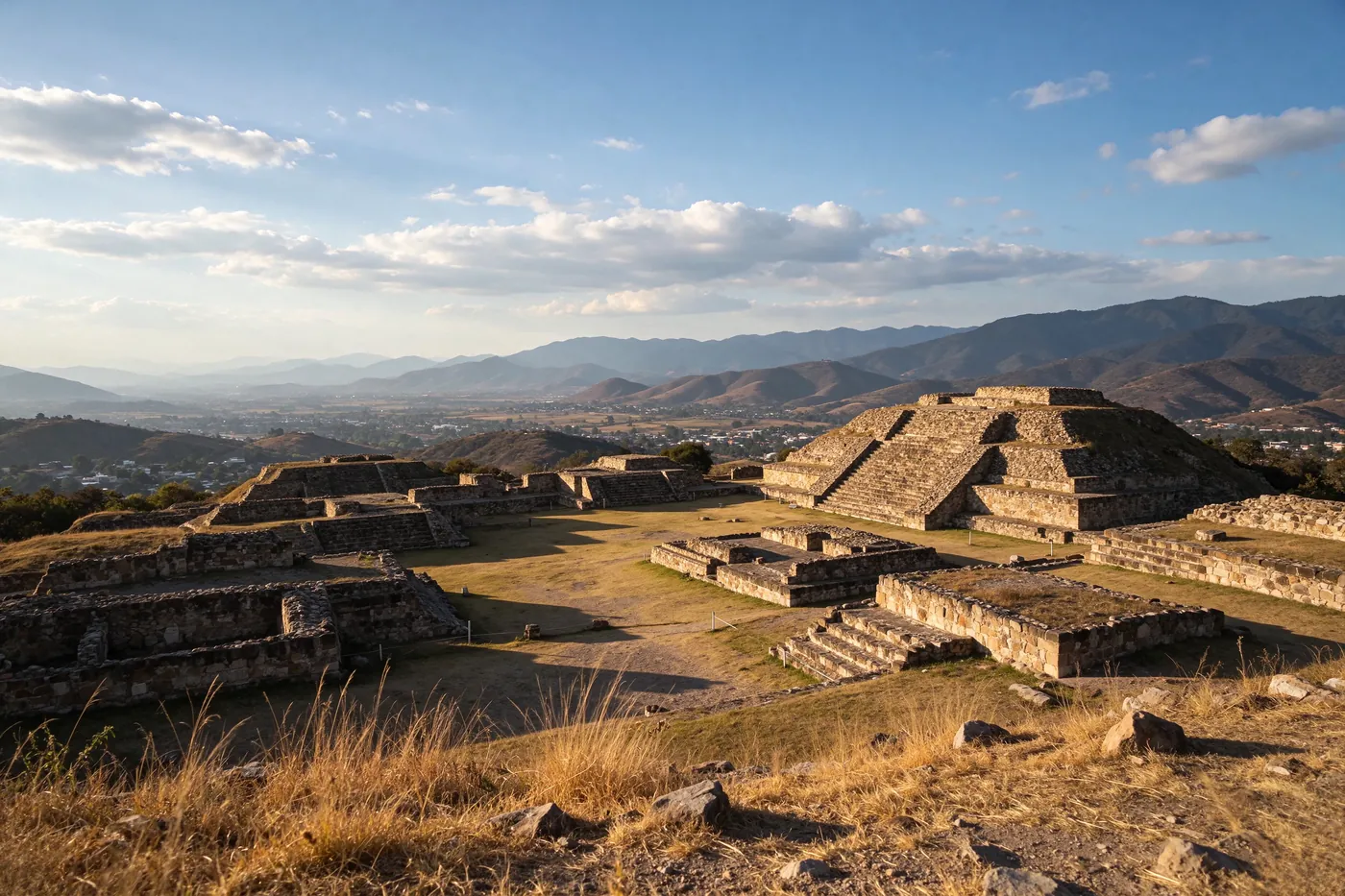
Oaxaca is not an easy place to summarise: a mountain state with sixteen recognised indigenous groups, a coastline, a highland valley, and a food culture that changes every hour you drive. The ten facts below do most of the work. Understand them and the market stops being a series of things that look good.
Where the food actually comes from
1. Corn and squash were domesticated here
The valley sits at roughly 1,550 metres above sea level, with a mild climate that never gets punishing in either direction. That let the earliest Zapotec and Mixtec farmers tame a remarkable range of plants: maize, squash, beans, chile, tomato, avocado and cacao all have deep roots here. Turkeys, deer and iguana were on the menu long before pork arrived. When you eat a tetela or drink an atole, you are eating from a plant library assembled on this ground over millennia.
2. People have lived in this valley since 11,000 BC
Caves near Mitla carry evidence of human habitation going back roughly thirteen thousand years. Farming settlements appear between 5,000 and 2,000 BC. By 500 BC the Zapotec had settled much of the central valley and were raising Monte Albán on its ridge. The Mixtec pushed in two centuries later, the Aztecs took control in the mid-fifteenth century, and the Spanish arrived with Cortés. Every layer left something in the kitchen. A single market stall can hold pre-Hispanic herbs, a colonial-era bread and a cheese introduced by Dominican friars.
The city, the villages and the table
3. The Centro and Monte Albán are both UNESCO World Heritage sites
Both were inscribed in 1987. The historic centre is largely sixteenth-century, with baroque churches and houses built by indigenous hands to European plans. Monte Albán has survived centuries of earthquakes that flattened other pre-Hispanic cities. For a hungry visitor, the upshot is that the same few square blocks hold the markets, the churches, the chocolate mills and the kitchens. You can walk from a Zapotec stone platform in the morning to a colonial courtyard at lunch without leaving the grid.
4. Each village around the city specialises in a craft
This is the detail that surprises people most. The valley is ringed by towns that have spent generations perfecting one thing: the handwoven wool rugs of Teotitlán del Valle, the burnished black pottery of San Bartolo Coyotepec, the carved alebrijes of San Martín Tilcajete, the green-glazed ceramics of Santa María Atzompa. Food follows the same logic. Villages are known for a bread, a mezcal, a cheese or a way with a comal, and families still run the workshops and kitchens themselves. It is why an Oaxaca Eats tour can move through four seated restaurant stops and still feel like one story about one valley.
5. Oaxaca is one of Mexico’s gastronomic capitals
The nickname is “the land of seven moles,” because each of the state’s seven regions makes its own version of the sauce — different chiles, different nuts, different patience. The everyday repertoire is just as deep. Order your way through this list and you will have a decent first week:
- Tlayuda — a large, thin, toasted tortilla with beans, quesillo and a choice of meats.
- Cecina — thin-cut beef or pork, cured and grilled over the fire.
- Chapulines — toasted grasshoppers with chile, lime and salt.
- Squash blossom soup — a light broth that shows off the valley’s produce.
- Tamales — steamed in corn husks or banana leaves, sweet or savoury.
- Huitlacoche — the dark, earthy corn fungus, best inside a quesadilla.
Seasoning comes from herbs you will not find at home: pitiona, hoja santa, chepiche and epazote. One of the best breakfast cafés in the city takes its name from chepiche, which tells you how seriously the herb is taken here.
Who lives here, and what they call the place
6. It is Mexico’s most ethnically and linguistically diverse state
Of Oaxaca’s 570 municipalities, 418 are predominantly indigenous, and more people speak an indigenous language here than in any other Mexican state. Zapotec and Mixtec are the largest groups, with smaller languages holding on in the mountains. The terrain is the reason: communities separated by ridges developed their own words, recipes and festivals. That is why the food is not one cuisine but dozens, and why a sauce standard in one village is unknown twenty minutes down the road.
7. The name comes from Nahuatl, not Zapotec
The Aztecs garrisoned the hill now called Cerro del Fortín and named the place Huāxyacac, meaning “place of the guaje trees.” Spanish scribes turned the “sh” sound into the modern Mexican “j,” which is why the city is pronounced wa-HA-ka rather than wa-SHA-ka. The guaje still grows along streets and hillsides; look for long, flat, seed-filled green pods. They are edible, and they turn up in local cooking. The city’s name is, quite literally, a tree you can eat from.
8. Oaxaca is the home of mezcal
Agave grows across the state, and mezcal is distilled from it in family palenques where the hearts are roasted in earthen pits, crushed, fermented and run through copper stills. The smoke in the glass comes from that pit, not from a flavouring. Taste it in the Centro’s mezcalerías or drive out to a palenque and watch the process. Either way, order it neat, in a small copita, and sip it slowly, with food on the table and nowhere else to be.
9. Benito Juárez came from here
Juárez was born into a poor Zapotec family in the Oaxacan countryside, studied law, entered politics, and became the first Mexican president of indigenous descent. He is best remembered for leading the resistance to French occupation in the 1860s. After his death the city added “de Juárez” to its name, and his birthday, 21 March, is a national holiday — an honour no other Mexican individual has received. His name is on streets, schools and one of the busiest markets in the Centro.
10. Guelaguetza is the state’s biggest party
On the last two Mondays of July, dancers from all seven regions gather in the open-air amphitheatre on Cerro del Fortín — the white, tent-like structure on the hill west of the city — to perform their music and dances in regional dress. The word refers to reciprocal exchange: you give what you have, and the giving comes back to you. Between performances, the city fills with the food, drink and crafts of the regions on show. If your dates line up with it, plan around it, because the whole city does.
A practical tip for eating at altitude
The valley sits at about 1,550 metres, and the sun is stronger than the temperature suggests. Drink more water than you think you need, go easy on mezcal your first night, and eat your largest meal at midday — the local comida corrida tradition exists for exactly that reason. If you are visiting during Guelaguetza week, reserve restaurants and tours well ahead.
Eat your way through the evidence
None of this is background colour. It is the reason the mole at one stop tastes nothing like the mole at the next, and the reason the woman selling herbs in the market can tell you which one belongs in a soup and which one belongs on a wound. Oaxaca Eats runs small walking tours — groups of four to six, four seated restaurant stops, up to fifteen tastings — in English, meeting at Calle Macedonio Alcalá 501. Five percent of every ticket goes to local charities. Come hungry and ask questions.