
Oaxaca food
Street Food in Oaxaca: What to Eat and When
Oaxaca’s restaurant cooking gets the headlines, but the city runs on its carts and corner stands, and they keep a schedule. Consomé and memelas belong to the morning, empanadas de amarillo to the middle of the day, tlayudas and al pastor to the hours after dinner. Learn the timetable and you can eat four good meals a day without ever sitting down properly.
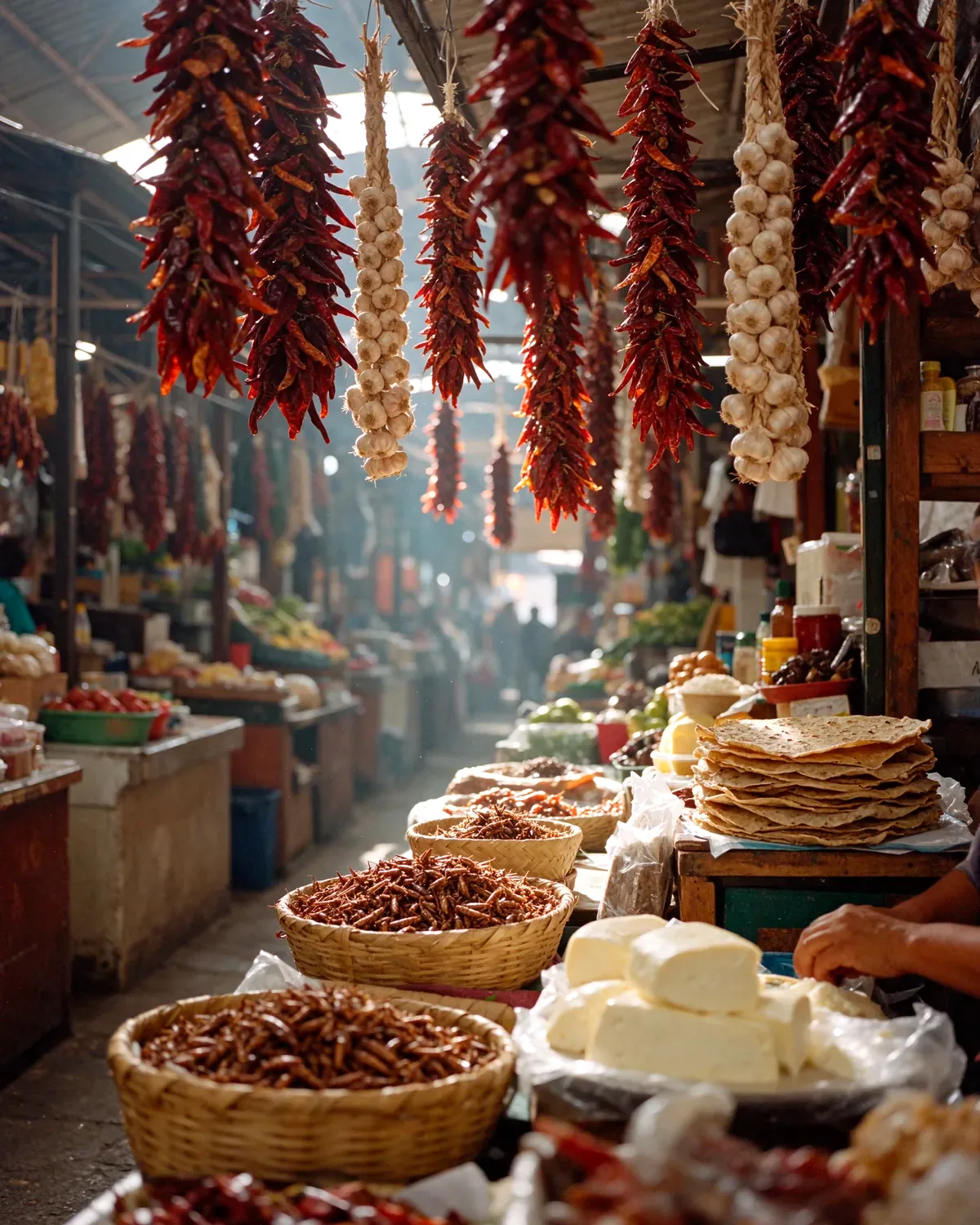
Street food here is not a single scene. It is a series of small, punctual economies: the women with the comal at six in the morning, the taco stands that open at noon, the trompo that starts turning at dusk, the marquesita cart that appears when the bars begin to empty. Show up at the right hour and you get food that was made for that hour.
Morning: consome, memelas and a cup of tejate
Consomé is the first thing to order. Served by the cup, it is a clear broth holding strips of beef or goat cooked until they give way at the touch of a spoon, finished with onion, cilantro and salsa. It is what people drink standing up on the way to work, and it costs almost nothing.
Memelas are the Oaxacan breakfast proper: a thick maize tortilla pressed and cooked on the comal, then layered with asiento (pork lard), refried beans, crumbled cheese and salsa. From there it is up to you — meat, huitlacoche, eggs, potato with chorizo, nopales. Order one and you will understand why the same stand has a queue of people who eat there every morning.
Tamales are everywhere, and in Oaxaca they are usually wrapped in banana leaf rather than corn husk, which gives the masa a softer, greener flavour. The tamal oaxaqueño comes with mole and chicken; others are stuffed with herbs, beans, pickled chile, or something sweet like pineapple or raisin. Order a guajolota if you want yours inside a bun, and an atole to drink.
Then there is tejate, which is a drink rather than a food but belongs in the same hour. It is pre-Hispanic: maize, toasted mamey seed, cacao and flor de cacao worked into a paste and mixed with water until a pale foam rises on top. It is served cold, in the half shell of a gourd, from market stalls and curbside tables in the morning.
Lunch and late afternoon: tacos, tortas and empanadas
Tacos need no introduction, but the Oaxacan versions do. Alongside al pastor shaved from the trompo, look for the chile relleno tacos at Tacos del Carmen, a stand we send guests to when they ask where to eat on their own time. Some vendors fold their tortillas around fillings that are more traditional than fashionable — tongue, brain, intestine — and they are worth ordering if you are curious.
Tortas are a snack here rather than a meal, despite the size. A crisp roll, refried beans, mayonnaise, cheese, your choice of meat, grilled onion and pepper, tomato, and verduras en vinagre: pickled vegetables and chiles that cut through all of it.
Empanadas de amarillo are distinctly Oaxacan and look more like a quesadilla than the empanadas you know from elsewhere. Shredded chicken and mole amarillo are folded inside a corn tortilla, cooked on the comal and handed over hot. Order one as a mid-afternoon stop rather than a full meal.
By mid-afternoon the cold carts take over. Nieves and paletas appear in the plazas, in Parque Llano and Jardín Conzatti, and on the terrace of nieve vendors beside the Basílica de la Soledad. Nieves Chagüita in Mercado Benito Juárez is a reliable stop. Try leche quemada con tuna — burnt milk with prickly pear — or maracuyá con mezcal if it is on offer. Raspas are the local snow cone, shaved off a block of ice by a raspador and pumped with tamarind, rompope, chocolate or strawberry syrup.
After dinner and late into the night
Tlayudas are the reason to stay out. A large tortilla goes over charcoal until it crisps and chars, the cheese melts inside, and then it is loaded with beans, asiento, cabbage or lettuce, tomato and your choice of meat, finished with the local herbs chepiche or huaje and a few radishes. Eat one on a plastic stool at a night stand, or sit down for a version at one of the market food halls — Mercado 20 de Noviembre is the classic address for grilled meat and tlayudas under one roof.
Al pastor is the late-night standard: pork stacked on the vertical trompo, shaved into a tortilla with pineapple, onion and cilantro. Wherever there is a bar, there is a trompo within a block of it.
Esquites and elote arrive in the early evening and stay late. Esquites come in steaming cups, creamed corn with chile, lime and mayonnaise; elote is the whole cob, grilled and dressed the same way, or served on a corn leaf under a heavy dusting of chapulines. It is the right thing to eat while you decide where to eat next.
For dessert, follow your nose. Marquesitas are made on cart griddles all over the city — a thin, crisp crepe rolled like a taco and filled with combinations of cheese, chocolate, jam or fruit; strawberry jam with cream cheese is the local favourite. Roasted bananas announce themselves with a whistle: look for the oven on wheels with a smokestack, and order one with condensed milk.
Hamburgers and hot dogs deserve a mention too, if only because the toppings are absurd and at least one of the sauces will be made with chapulines. They exist for the same reason they exist everywhere: the bars close late.
How to choose a stand
The rules are the same ones good eaters use in any city, with a few local adjustments.
- Follow the queue. A line of people who eat there every day is the best assurance of turnover and freshness.
- Look at the comal. A clean, hot cooking surface and a vendor working steadily tell you more than any sign.
- Order what they do best. Most stands make one or two things. Ask what is good today and take the answer.
- Go at the busy hour. A cart with nothing cooking at four in the afternoon is a different proposition from the same cart at eight in the evening.
- Carry small notes. Change is limited, especially late at night.
A practical tip on timing
Do not try to eat the whole list in one day. Pick one hour and eat it properly: consome and a memela before nine, an empanada de amarillo around three, a tlayuda after ten. And if you are joining a food tour, eat light beforehand — our walks include four seated restaurant stops and up to 15 tastings, which is a full afternoon of eating on its own.
Where our tours fit
Oaxaca Eats Food Tours is a walking company, so the street food is part of the route rather than a separate expedition. Groups are four to six people, guides lead in English, and the meeting point is Calle Macedonio Alcalá 501 in the Centro. The Classic Downtown tour covers market stalls, mole negro and mezcal espadín alongside four seated restaurant stops; the Sunset tour heads out later, when the trompos are turning. Five percent of every ticket is donated to two local organizations.